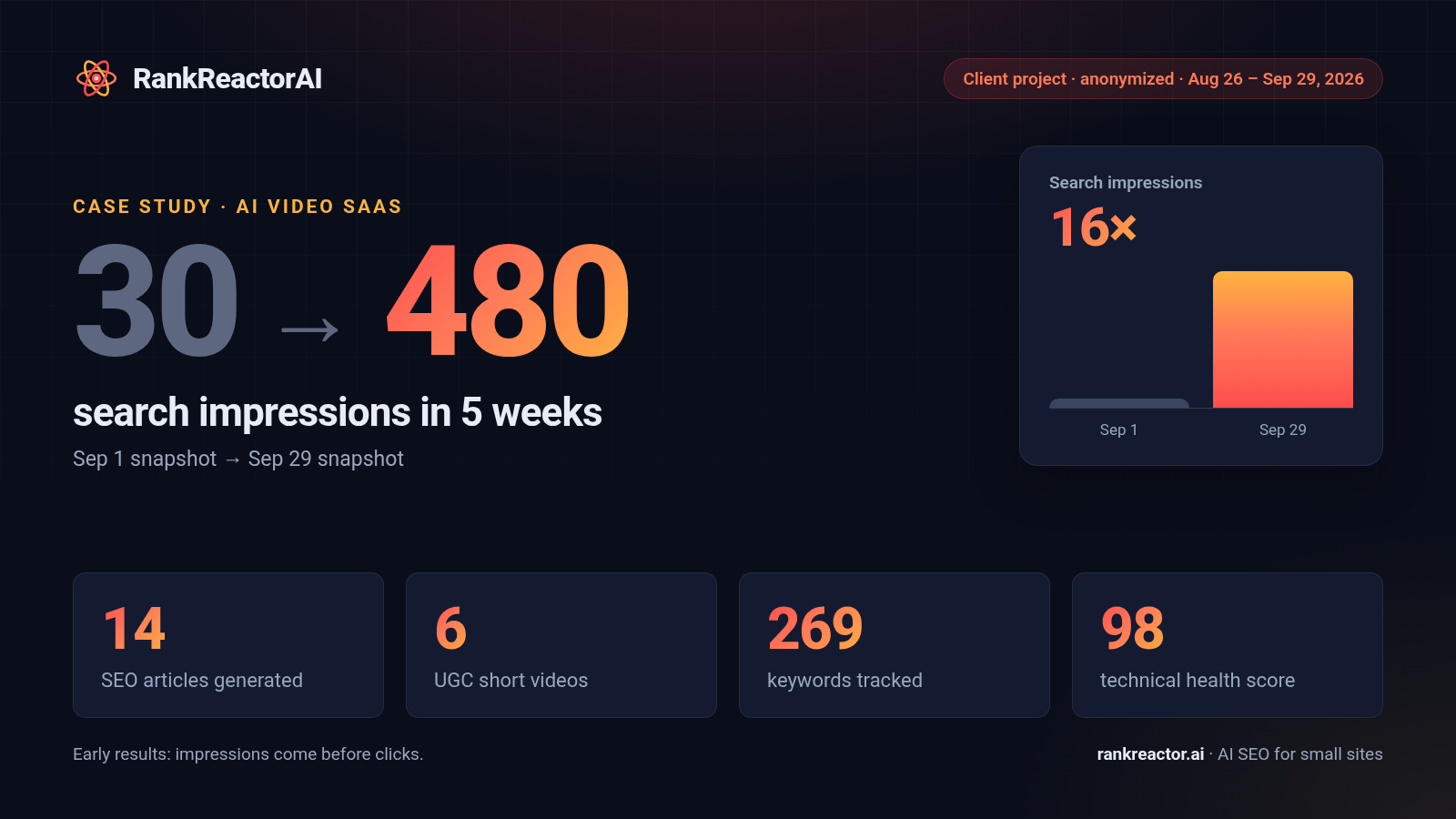
Client project, anonymized. Data from Aug 26 to Sep 29, 2026.
We don't publish many case studies yet, because most of our projects are still young. But this one shows the first stage of SEO pretty clearly, and it's honest about what that stage looks like. So here it is, numbers and caveats included.
The client is an indie hacker running a small AI video SaaS. We're keeping the site anonymous, so you won't see the name, the URL or any of its content here. What you will see are the real numbers from our dashboard.
The problem: traffic sliding, no time to write
The founder had the same problem most solo builders have. The product was shipping, but nobody was writing content, and organic search was slowly drying up.
Here's what monthly organic clicks looked like before the project started. In 2026, monthly organic clicks went from 46 in March to 45 in April, 43 in May and June, 22 in July, and 13 in August.
That's not a crash. It's a slow leak that suddenly speeds up. Between June and August, clicks fell by about 70%.
The cause wasn't a mystery. Search engines reward sites that keep publishing useful, relevant pages, and this site had basically stopped. The founder knew content was the fix but didn't have the hours to research keywords, write articles, make videos and track all of it while also running the product.
That's the gap RankReactor is built for.
What RankReactor did
The project kicked off on August 26, 2026. Here's what ran over the next five weeks.
1. Keyword research and tracking. RankReactor built a keyword universe around the product's niche. On September 1 it was tracking 322 keywords. By September 29 it had been trimmed to 269, as weak or irrelevant terms were dropped and the focus narrowed to the ones worth chasing. Fewer, better keywords is the goal, not a bigger list.
2. Articles. RankReactor generated 14 articles targeting those keywords, and 13 of them were published through our partner blog network, pointing back to the site.
3. Supporting content across our partner blog network. Between September 7 and October 2, 27 supporting articles went out across RankReactor's partner blog network to give the site relevant context and mentions beyond its own pages.
4. UGC-style short videos. RankReactor produced 6 short UGC-style videos. Short video is one of the cheapest ways for a small product to show up in more places, and it's one of the first things a busy founder drops.
5. Technical health check. The site's technical audit came back with a health score of 98. That matters because content can't do much if search engines struggle to crawl the site. Here, the foundation was already solid, so all the effort could go into content.
The founder didn't write any of this. That's the point.
Results so far
The headline number is search impressions: 30 in the September 1 snapshot and 480 in the September 29 snapshot. That's 16x, snapshot to snapshot.
A quick note on that number. The two snapshots may not cover identical measurement windows, so we're not going to dress it up with precise growth percentages. What it does show is direction: search engines are surfacing the site for a lot more queries than they were a month earlier.
Here's the full five-week snapshot. Search impressions went from 30 to 480 (Sep 1 snapshot to Sep 29 snapshot). RankReactor generated 14 articles and published 13 of them through the partner blog network. It added 27 supporting articles across the partner network and produced 6 UGC short videos. It's tracking 269 keywords, and the technical health score is 98.
What we're not claiming
It's about five weeks in, and that's early for SEO. We aren't claiming ranking wins or a traffic turnaround yet. Impressions come before clicks. First a search engine starts showing your pages, then it tests where they belong, and clicks follow as pages move up for the terms people actually search.
So right now this project is in the "getting seen" stage. That's the stage the site hadn't reached at all while it wasn't publishing.
What's next
The next phase is turning impressions into clicks.
First, keep publishing on the narrowed keyword list, prioritizing terms that already get impressions. Second, improve the pages that are getting seen but not clicked, starting with titles and meta descriptions. Third, keep making short videos alongside articles so the site shows up in more than one format. Finally, re-measure at roughly 60 and 90 days and share what changed, good or bad.
We'll post an update when there's real click data to talk about.
The takeaway for indie founders
If your organic traffic is slowly slipping and you know content is the fix but never find the time, you're not alone. Most of the work isn't hard. It's just constant: research, writing, video, tracking, repeat.
RankReactor does that loop for small sites. It generates SEO articles, makes UGC-style short videos and tracks your keywords, so you can get back to building.
Want to see where your own site stands? Try our free SEO tools at rankreactor.ai/tools, or start a project at rankreactor.ai.